
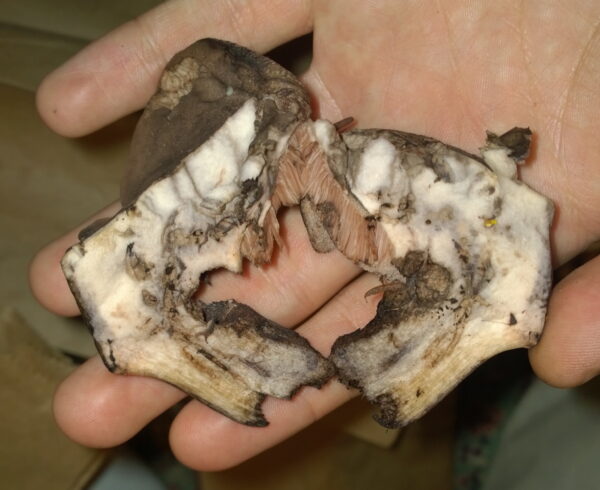
Description
Genus: Neoporphyrellus (See the Science Notes)
- Genus 2: Tylopilus
Species: atratus
Common Name: “False Black Velvet Bolete”
Tells: Think “N. alboater or N. atronicotianus, but under hemlock.” Gray to black velvety cap often cracks even when young. White cap flesh slowly blackens w/no red phase.
Other Information: White pores soon age to cocoa & stain red- to blackish-brown. Occasionally twisted stem is white on top & dark below. Cap flesh odor described as “musty.” Found in Western New York State, the limits are unknown. A smaller mushroom <3½” tall or across. N. alboater (Black Velvet Bolete) and N. atronicotianus like oak rather than hemlock, stain pinkish or red before slowly resolving toward black, & have pores that age toward pink rather than brown.
Science Notes: Is this a real species? Probably not, but the negative isn’t strong enough to rule things out. The tale goes like this. In 1998 Ernst Both, an extremely talented and well respected mycologist, published a paper describing N. atronicotianus, the lookalike species for the well known N. alboater. The cap was brown rather than black, the flavor was off, the overall look and feel wasn’t quite right, etc. DNA studies have since proved him right, and also moved the pair from Tylopilus (based on the pink spores) into a new genus called Neoporphyrellus. Both also published a third species he called atratus, based on the twin facts that it grew with hemlock instead of oak, and bruised directly to gray/black without an intermediate pink/red state.
Both’s holotype has been lost, no reliable find has ever been found since the first publication, and we’ve since learned that atronicotianus has more variability than originally thought. OTOH, Both was so very, very good that no one doubts he really did find this critter when, where, and as described, with no question about some secret oak association from a faraway tree. So… did he simply find an oddball version growing on the wrong tree, with strange bruising? Or is it a rare species that we still need to consider? If you live anywhere around the eastern half of Lake Erie and make a potential find around hemlock, make sure to get it tested ASAP!
Edibility: Unknown.
CHEMICAL TESTS:
- NH4OH (Ammonia): No data.
- KOH: No data.
- FeSO4 (Iron Salts): No data.
Links:
 |
0 |  |
0 |  |
259 |  |
366 |
Got something to discuss?